How Modern AI Chatbots Actually Generate Answers
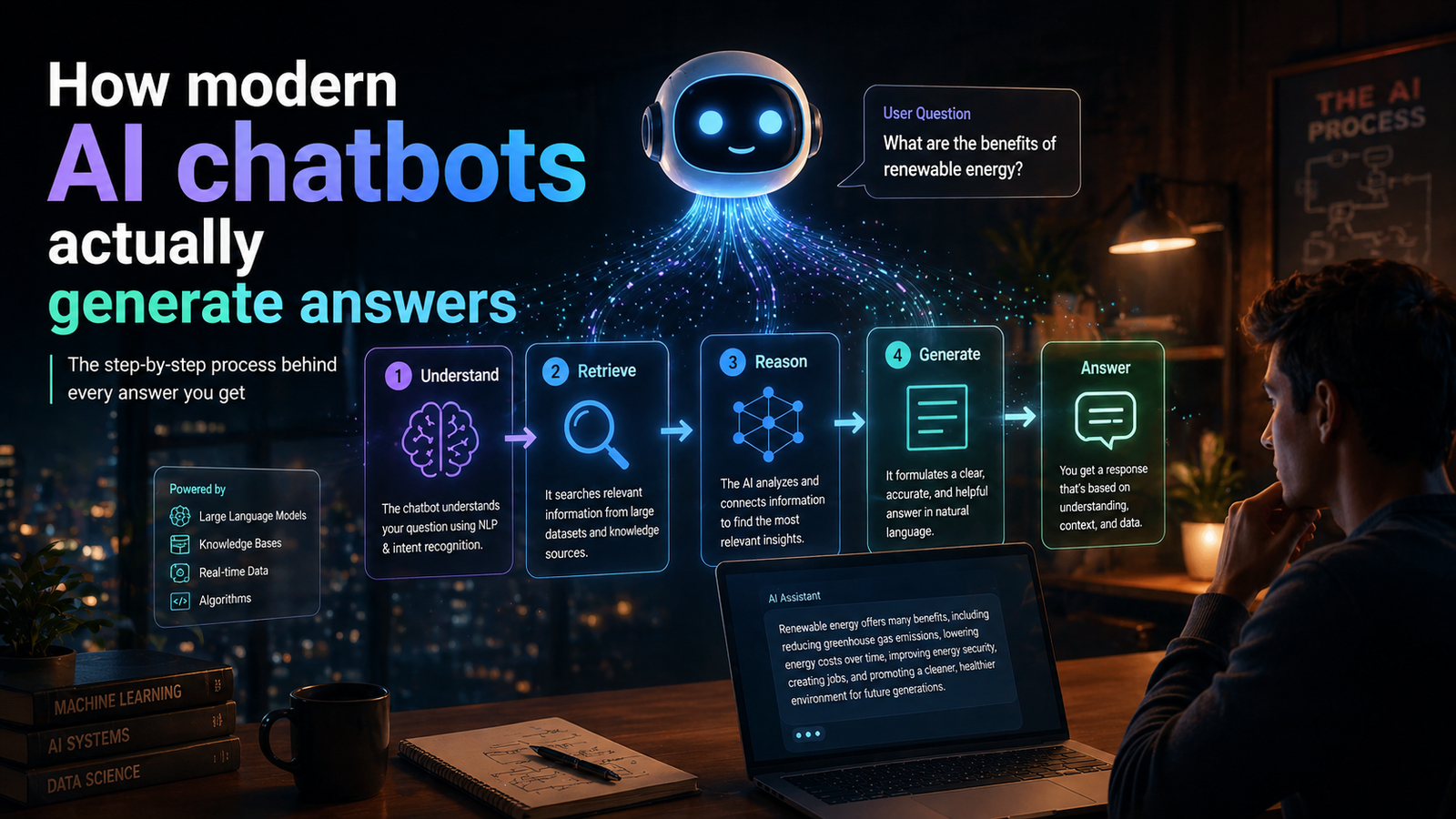
How Modern AI Chatbots Actually Generate Answers
Artificial intelligence chatbots aids in many facets of everyday life, from answering questions and writing content to helping with coding and customer support. Tools like ChatGPT and other AI assistants often feel surprisingly human in how they respond.
But behind the smooth conversations, there’s no real thinking, intention, or understanding in the human sense.
So how do modern AI chatbots actually generate answers?
What Is an AI Chatbot?
An AI chatbot is a software system designed to simulate human conversation using natural language. Instead of following rigid scripts, modern chatbots generate responses dynamically based on patterns learned from data.
They don’t “know” things the way humans do—they generate text based on probability.
Examples of Modern AI Chatbots
Today’s most advanced chatbots include tools used for:
- Writing and content generation
- Programming assistance
- Customer support
- Education and tutoring
These systems are powered by large AI models trained on vast amounts of text.
Key Difference Between Rule-Based and AI Chatbots
Older chatbots were rule-based. They followed predefined scripts and could only respond to specific inputs.
Modern AI chatbots are generative. Instead of selecting a fixed response, they create new sentences each time based on learned language patterns.
The Core Technology Behind AI Chatbots
What Is a Large Language Model (LLM)?
At the heart of modern chatbots is something called a Large Language Model (LLM).
An LLM is trained on massive amounts of textbooks, articles, websites, and more. Its main job is simple in concept: predict the next word in a sentence.
That might sound basic, but at scale, it becomes incredibly powerful.
Understanding Tokens and Probabilities
AI models don’t see text the way humans do. They break language into smaller pieces called tokens.
For example:
- “Chatbots are useful” → may be split into multiple tokens
The model assigns probabilities to possible next tokens and selects the most likely one based on context.
Neural Networks and Transformers Explained
Modern chatbots use a type of neural network called a transformer.
The key innovation in transformers is something called attention. This allows the model to:
- Focus on relevant parts of a sentence
- Understand relationships between words
- Maintain context across long inputs
This is why responses feel coherent and context-aware.
How AI Chatbots Generate Answers
Step 1: Input Processing (Prompt Understanding)
When you type a question, the chatbot:
- Breaks your text into tokens
- Analyzes structure and meaning
- Identifies key patterns in your input
This step does not involve “understanding” in a human sense. It is pattern recognition.
Step 2: Context Mapping and Pattern Matching
The model compares your input with patterns it learned during training.
It doesn’t search a database for answers. Instead, it uses statistical relationships between words and concepts.
Step 3: Predicting the Next Word
This is the core process.
The model:
- Predicts the most likely next token
- Adds it to the response
- Repeats the process step-by-step
Each word is generated based on probabilities and context.
Step 4: Response Formation
As tokens are generated, they form sentences.
The model balances:
- Grammar
- Coherence
- Relevance
This is why responses feel structured and natural.
Step 5: Output Delivery
Once the response is complete:
- It is presented to the user
- Additional filters or system rules may refine it
The entire process happens in seconds.
Training AI Chatbots: Where Their Knowledge Comes From
Pretraining on Large Datasets
AI models are trained on massive datasets that include:
- Books
- Websites
- Articles
- Code repositories
This helps them learn language patterns, facts, and structures.
Fine-Tuning and Human Feedback
After pretraining, models are refined using human feedback.
This process, often called Reinforcement Learning from Human Feedback (RLHF), helps:
- Improve accuracy
- Reduce harmful outputs
- Make responses more helpful
Continuous Updates and Limitations
Even advanced models have limits:
- They may have a knowledge cutoff
- They don’t automatically know real-time events
- Updates require retraining or system integration
Why AI Chatbots Sometimes Give Wrong Answers
Hallucinations Explained
One of the biggest challenges is hallucination.
This happens when a chatbot generates information that sounds correct but isn’t. At the same time, it is not lying but predicting text that looks plausible.
Lack of Real-Time Understanding
AI chatbots don’t inherently:
- Verify facts
- Access live data (unless connected to external systems)
- Understand truth vs falsehood
They generate based on patterns, not verification.
Bias in Training Data
Since models learn from human-generated data, they can reflect:
- Biases
- Incomplete perspectives
- Cultural assumptions
This can influence responses in subtle ways.
Do AI Chatbots Actually “Understand” What They Say?
The Illusion of Understanding
AI chatbots can explain complex ideas clearly—but this doesn’t mean they understand them.
They simulate understanding by generating language patterns that resemble human reasoning.
Statistical Prediction vs Human Thinking
Humans:
- Think consciously
- Have intentions
- Understand meaning
AI systems:
- Predict text
- Follow probabilities
- Have no awareness or intent
Expert Opinions and Debates
There is ongoing debate among experts about:
- Whether advanced AI approximates understanding
- The limits of language-based intelligence
- The future of machine cognition
But most agree: current systems do not truly “think.”
Key Components That Improve AI Chatbot Responses
Prompt Engineering
The way you ask a question matters.
Clear, specific prompts lead to better responses because they:
- Provide stronger context
- Reduce ambiguity
Context Windows and Memory
AI chatbots can remember parts of a conversation within a limited window.
This allows them to:
- Maintain continuity
- Refer back to earlier messages
However, this memory is temporary and limited.
Retrieval-Augmented Generation (RAG)
Some advanced systems combine AI with external data sources.
This approach:
- Retrieves relevant information
- Uses AI to generate responses based on it
It improves accuracy and reduces hallucinations.
Real-World Applications of AI Chatbots
Customer Support Automation
AI chatbots handle:
- FAQs
- Troubleshooting
- User assistance
This reduces workload for human agents.
Content Creation and Writing
They are widely used for:
- Blog posts
- Emails
- Marketing content
Coding Assistance
Developers use AI to:
- Write code
- Debug errors
- Explain concepts
Education and Tutoring
AI helps learners by:
- Explaining topics
- Answering questions
- Providing study guidance
The Future of AI Chatbots
More Accurate and Reliable Models
Future models will likely:
- Reduce hallucinations
- Improve reasoning
- Provide more reliable outputs
Multimodal AI (Text, Image, Video)
AI is expanding beyond text to include:
- Images
- Audio
- Video
This creates more interactive experiences.
Ethical and Regulatory Developments
As AI grows, so does the need for:
- Ethical guidelines
- Transparency
- Regulation
These will shape how AI is used globally.
see also: How to Use AI in Marketing Without Losing Customer Trust