E-E-A-T: How to Build Trust and Boost Web & AI Visibility
As artificial intelligence reshapes digital search, one principle continues to dominate modern SEO strategy: trust.
Search engines are no longer focused solely on keywords and backlinks. Today, visibility depends heavily on credibility, authenticity, expertise, and user confidence.
That is precisely why Google’s E-E-A-T framework has become increasingly important in both traditional search rankings and AI-generated search visibility.
The conversation around E-E-A-T: How to Build Trust and Boost Web & AI Visibility is no longer reserved for SEO professionals alone. Brands, publishers, creators, and businesses must now understand how trust signals influence both human audiences and AI systems.
As generative AI becomes more deeply integrated into search experiences, content quality standards are rising rapidly. Search engines want reliable information. AI systems want verifiable authority. Users want trustworthy answers.
E-E-A-T sits directly at the center of all three.
What Is E-E-A-T?

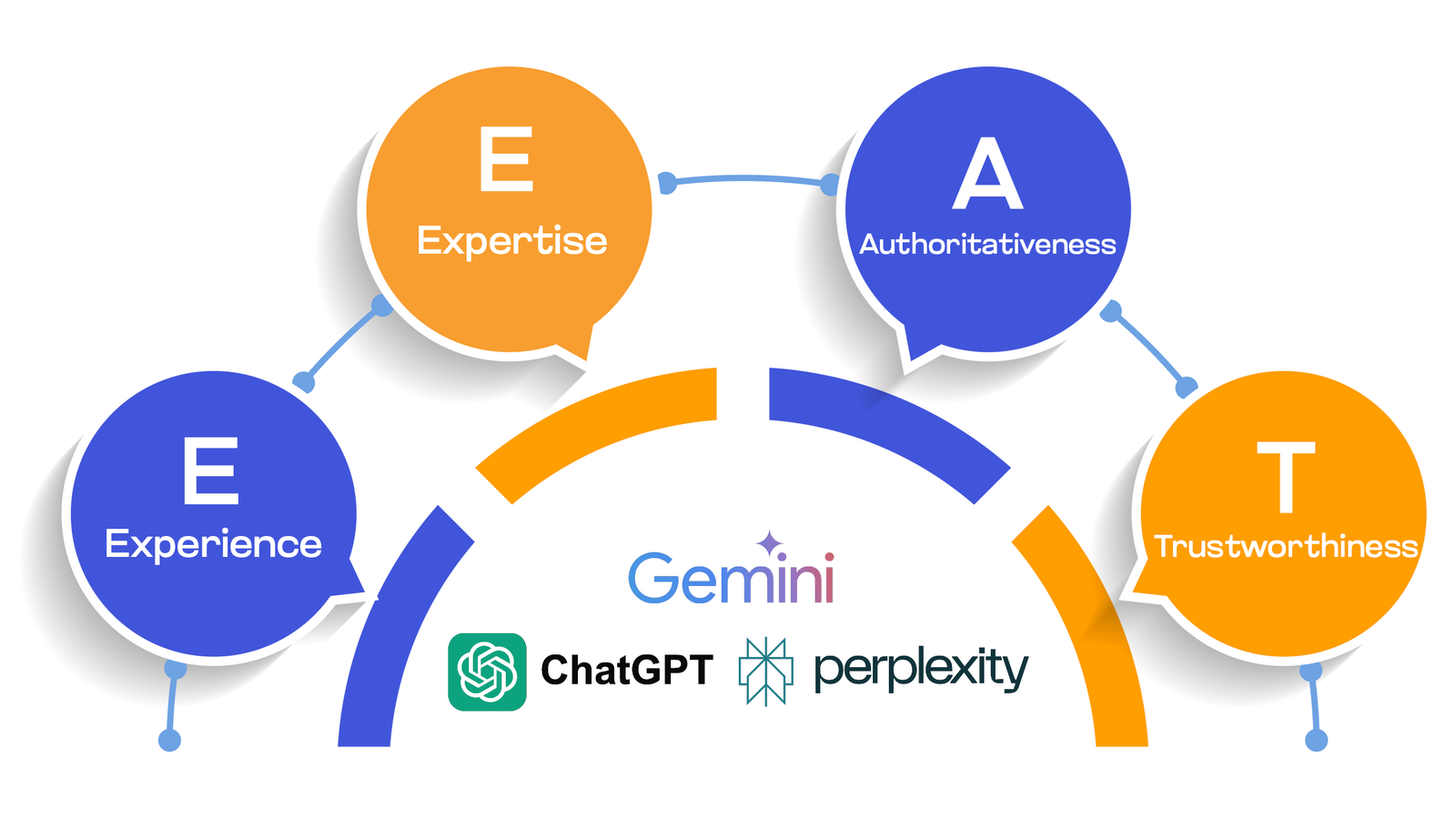
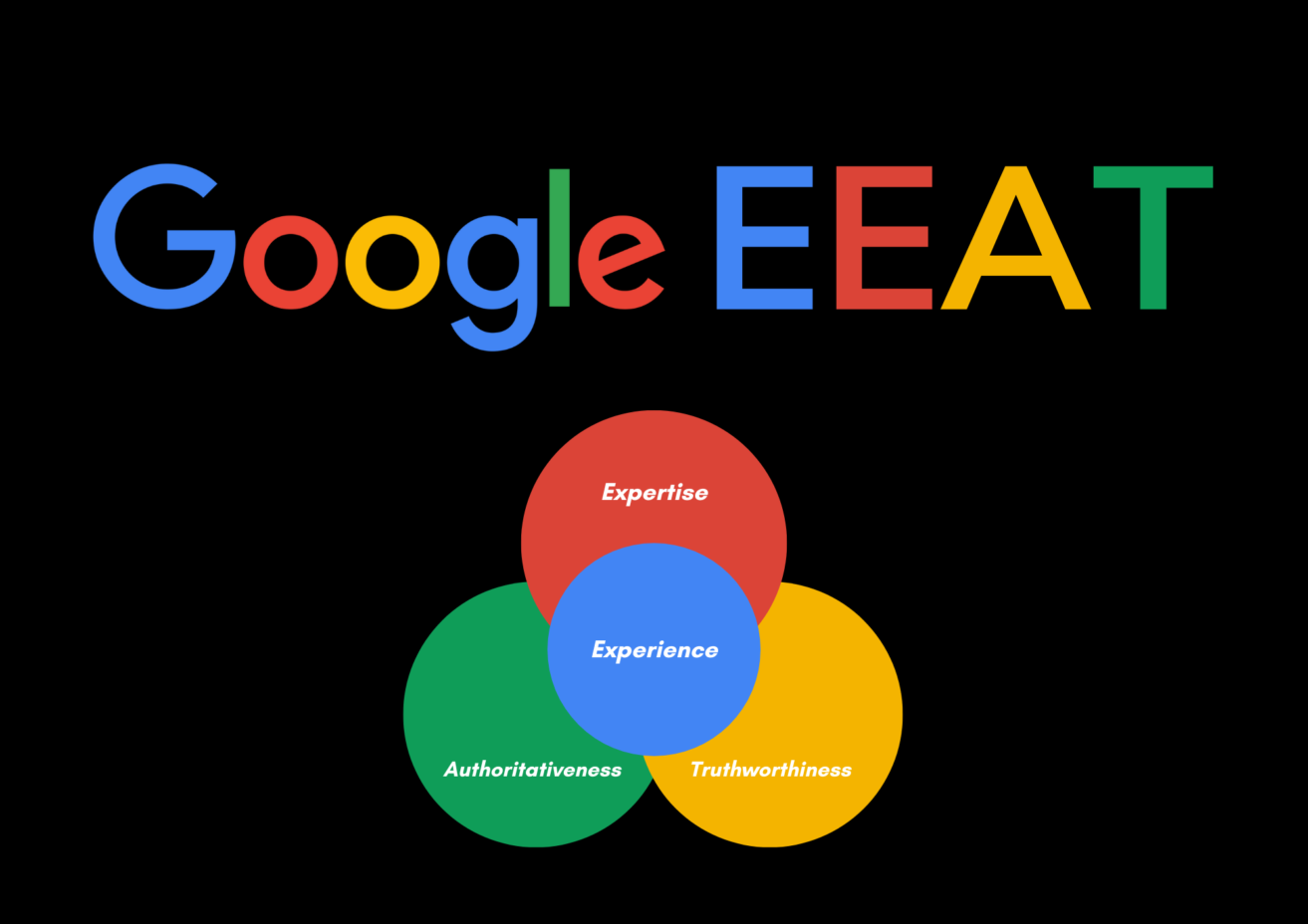
E-E-A-T stands for Experience, Expertise, Authoritativeness, and Trustworthiness. The framework originates from Google’s Search Quality Evaluator Guidelines and functions as a foundational model for evaluating content quality across the web.
Originally introduced as E-A-T, Google later expanded the framework by adding an additional “E” for Experience in 2022. That addition reflected an increasingly important reality: firsthand knowledge matters.
Search systems now place greater emphasis on content created by individuals with genuine real-world involvement, whether that involves product usage, industry participation, professional expertise, or personal experience.
E-E-A-T is not a single ranking factor. Rather, it is a collection of quality signals influencing how algorithms interpret credibility and usefulness.
Why E-E-A-T Matters More in the AI Era
The rise of generative AI has dramatically altered how information is created, distributed, and consumed.
AI-powered systems can now generate articles, summaries, outlines, reports, and answers within seconds. While this creates remarkable efficiency, it also floods the internet with repetitive, low-value, and often unreliable information. This shift has made trust signals far more important.
Google has repeatedly clarified that AI-generated content itself is not inherently problematic. What matters is quality.
Content created purely to manipulate rankings or mass-produce low-value pages is treated as spam, while genuinely useful content demonstrating strong E-E-A-T signals can still perform exceptionally well.
That distinction changes everything. In an environment overflowing with automated content, originality, expertise, and trust become major competitive advantages.
The brands thriving in AI-driven search are not merely publishing more content. They are publishing more credible content.
Understanding the Four Pillars of E-E-A-T
Experience
Experience focuses on firsthand knowledge and real-world interaction. Search engines increasingly value content created by people who have genuinely used a product, visited a location, tested a strategy, or worked within a specific field.
An authentic experience creates informational depth that generic AI summaries often lack.
A travel review written by someone who physically visited a destination carries greater trust than content assembled entirely from secondary sources.
Likewise, a software review becomes more credible when the author demonstrates actual product usage and practical insights. Real experience humanizes content and strengthens authenticity.
Expertise
Expertise evaluates the depth of subject knowledge demonstrated within content.
This includes professional qualifications, industry specialization, technical understanding, and the ability to explain complex concepts accurately and clearly.
Content produced by knowledgeable professionals naturally signals stronger expertise than shallow summaries lacking informational depth.
In industries involving finance, health, law, technology, or safety-sensitive information, expertise becomes even more critical because misinformation can create serious consequences. Search systems increasingly prioritize accuracy over volume.
Authoritativeness
Authoritativeness measures reputation and credibility within a broader ecosystem. This includes brand recognition, industry citations, expert mentions, backlinks from trusted publications, author credentials, media references, and broader online reputation signals.
An authoritative website is typically recognized by others as a reliable source of information.
Strong author bios, verified credentials, professional affiliations, and mentions across reputable platforms all contribute to stronger authority signals.
Authority is earned through consistent credibility over time.
Trustworthiness
Trustworthiness is arguably the most important component of E-E-A-T. Without trust, expertise and authority lose value.
Trust signals include transparent sourcing, factual accuracy, secure browsing experiences, visible contact information, editorial integrity, privacy protection, and honest communication practices.
Search systems increasingly reward websites demonstrating openness, reliability, and accountability.
Users must feel confident that the information they consume is accurate and dependable.
How E-E-A-T Connects to SEO, GEO, and LLMO
E-E-A-T operates as the underlying trust layer powering modern search visibility. Within traditional SEO, strong E-E-A-T signals help search engines evaluate whether content deserves stable rankings.
Author expertise, domain reputation, factual accuracy, and topical depth all contribute to stronger organic performance.
In GEO environments, E-E-A-T becomes even more influential because AI-generated summaries require information that can be synthesized confidently without risking misinformation. AI systems prefer sources that demonstrate expertise, transparency, and reliability.
For LLMO, E-E-A-T helps AI models determine which brands, authors, and organizations deserve recognition across broader conversational AI ecosystems. Content that consistently demonstrates authority and semantic clarity becomes more likely to appear in AI-generated discussions, recommendations, and references.
Put simply, SEO improves discoverability, GEO improves AI citation potential, and LLMO improves cross-platform AI recognition. E-E-A-T strengthens all three simultaneously.
Building an E-E-A-T Foundation for SEO
Strong E-E-A-T implementation begins with foundational credibility practices. Comprehensive author profiles strengthen transparency and expertise.
Regular content updates signal informational freshness and ongoing relevance. Reliable citations reinforce factual integrity, while strong internal linking structures demonstrate topical relationships and semantic organization.
Together, these elements establish a durable trust framework capable of supporting long-term search visibility across both traditional and AI-powered environments.
GEO Optimization and AI Citation Readiness
AI-generated summaries favor content that is easy to extract, interpret, and synthesize. Formatting, therefore, plays a critical role in citation eligibility.
Pages with clear heading hierarchies, concise informational blocks, direct explanations, and structured formatting perform significantly better within AI-driven environments. FAQ sections, answer-focused paragraphs, descriptive visuals, and schema markup all improve machine readability.
Content designed for AI extraction often includes self-contained informational passages that communicate complete ideas efficiently. These structured “answer nuggets” make it easier for AI systems to surface information accurately.
When strong E-E-A-T signals combine with AI-friendly formatting, citation potential increases dramatically.
LLMO and Cross-Platform Brand Authority
Large Language Model Optimization extends visibility beyond search engines into broader AI ecosystems. Modern AI systems continuously analyze relationships between brands, authors, expertise areas, and industry authority signals across the internet.
Consistency across platforms becomes essential. Organizations that maintain unified expertise positioning, contribute to respected publications, participate in industry discussions, and establish recognizable thought leadership build stronger authority graphs over time.
AI systems increasingly reward brands demonstrating stable, trustworthy expertise across multiple environments rather than isolated web pages alone. Authority compounds through repetition and consistency.
The Impact of AI on Content Creation and SEO
Artificial intelligence has transformed how marketing teams create and optimize content. AI-powered platforms can now generate outlines, automate keyword clustering, accelerate research workflows, and produce drafts at unprecedented speed.
Tasks that previously required hours of manual effort can now be completed within minutes.
This creates enormous efficiency gains. However, automation alone is not enough.
AI-generated drafts often lack emotional nuance, firsthand perspective, strategic differentiation, and experiential depth. Without human refinement, AI-produced content can feel generic, repetitive, and interchangeable.
The most effective modern SEO strategies combine AI efficiency with human intelligence.
That means enriching AI-generated content with original insights, expert analysis, proprietary data, case studies, and authentic storytelling that machines cannot easily replicate. AI may accelerate production. Humans still create trust.
Frequently Asked Questions
What Does E-E-A-T Stand For?
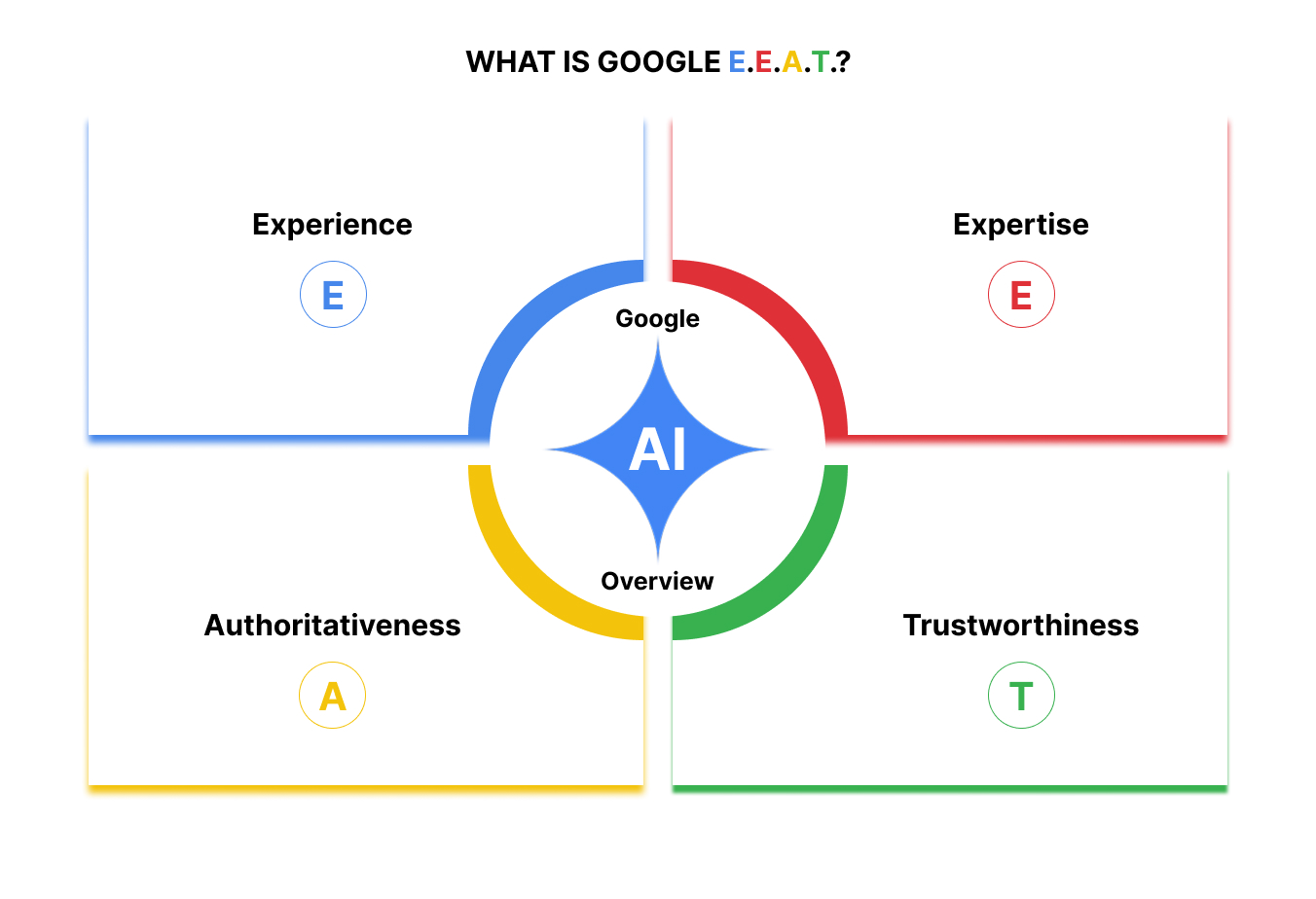
E-E-A-T stands for Experience, Expertise, Authoritativeness, and Trustworthiness. It is a framework used to evaluate the overall quality and credibility of content across the web. Originally introduced as E-A-T, it was later expanded to include Experience, reflecting the growing importance of firsthand knowledge in assessing content value.
Is E-E-A-T a Direct Ranking Factor?
E-E-A-T is not a direct ranking factor within search algorithms. Instead, it forms part of the quality evaluation principles outlined in Google’s Search Quality Rater Guidelines. These guidelines help assess whether content is helpful, reliable, and credible. Although indirect, strong E-E-A-T signals often correlate with improved visibility in search results and higher chances of being cited in AI-generated answers.
Which Element of E-E-A-T is Most Important?
Among all components, trustworthiness carries the highest weight. Search quality guidelines explicitly emphasize that without trust, the remaining elements lose their effectiveness. A page may demonstrate expertise or experience, but if it lacks trust signals such as accuracy, transparency, or credibility, it is unlikely to perform well in modern search environments.
How do I Demonstrate Experience if I'm New to a Topic?
Even if you are new, experience can still be communicated through transparency and honest documentation. Instead of overstating authority, focus on what you have genuinely done so far. This could include early-stage testing, personal learning observations, initial experiments, or step-by-step insights from your journey. AI systems and search engines increasingly value authenticity over exaggerated expertise.
Do Small Websites Have a Chance with E-E-A-T?
Yes, smaller websites can absolutely compete. While larger domains may naturally have stronger authority signals due to longevity and backlinks, niche websites often excel in demonstrating focused expertise and real-world experience. Search and AI systems evaluate content quality based on credibility and relevance, not just domain size. A small site with strong E-E-A-T signals can outperform larger competitors in specific topical areas.
How Long Does it Take to see E-E-A-T Improvements?
E-E-A-T is not a quick-win strategy. Building credibility, authority, and trust takes consistent effort over time. In most cases, meaningful improvements appear over several months rather than weeks. However, certain enhancements such as adding structured data, improving author transparency, and strengthening citations can provide early positive signals to search systems.
Should I Optimize My Content Differently for YMYL Topics?
Yes, content in “Your Money or Your Life” categories requires significantly stronger E-E-A-T signals. These topics influence health, financial stability, safety, or major life decisions, which means accuracy and credibility are critical. In such cases, content should ideally be created or reviewed by qualified professionals, supported by authoritative sources, and maintained with strict factual accuracy to meet higher trust standards.
How Do I Measure E-E-A-T Success?
Measuring E-E-A-T is more about patterns than single metrics. Success is often reflected in improved AI Overview citations, increased branded search activity, stronger presence in industry mentions, and more stable organic rankings over time. Rather than sudden traffic spikes, strong E-E-A-T typically results in consistency, resilience during algorithm updates, and growing recognition across AI-generated platforms. Some tools, such as an LLM SEO E-E-A-T score checker, can also provide structured evaluations of your content quality across different trust categories.
Related Searches: