AI in marketing: Benefits of AI in Marketing
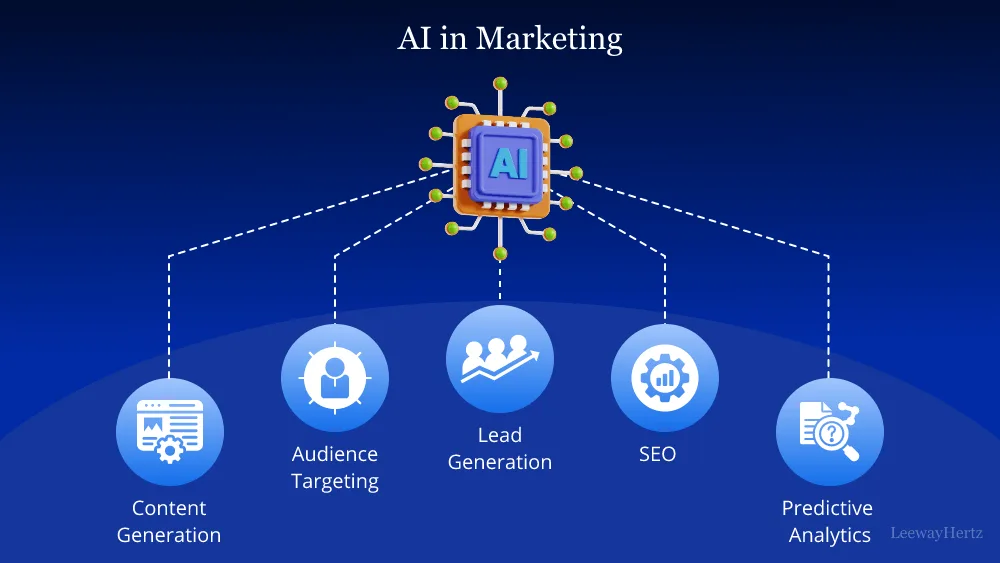
Artificial intelligence is rapidly transforming the marketing industry, changing how brands connect with audiences, create campaigns, and make business decisions.
Tasks that once required weeks of planning, testing, and analysis can now be completed in minutes with the help of AI-powered tools and automation systems.
From personalized advertising to predictive analytics, AI in marketing is helping businesses become faster, smarter, and more customer-focused.
As digital competition continues to increase, companies are turning to AI technologies to improve efficiency, understand customer behavior, and deliver more meaningful experiences.
Today, AI is no longer viewed as a futuristic concept in marketing; it has become an essential part of modern marketing strategies across industries.
What Is AI in Marketing?

AI in marketing refers to the use of artificial intelligence technologies such as machine learning, natural language processing, predictive analytics, and generative AI to improve marketing performance and automate processes.
These technologies help businesses analyze data, personalize customer interactions, optimize campaigns, and generate insights that support better decision-making.
Instead of relying entirely on manual processes, marketers can now use AI tools to streamline repetitive tasks, identify trends, and create highly targeted campaigns.
AI systems are capable of learning from customer behavior and continuously improving their recommendations over time.
In practical terms, AI in marketing can help businesses create personalized email campaigns, generate content ideas, automate social media scheduling, improve customer targeting, optimize ad spending, and predict future buying behavior.
This allows marketing teams to focus more on strategy, creativity, and customer relationships while AI handles complex data processing and automation.
How AI Is Changing Modern Marketing
One of the biggest reasons businesses are embracing AI is its ability to process enormous amounts of data quickly and accurately.
Modern consumers interact with brands through websites, social media, emails, search engines, and mobile apps. AI helps marketers combine and analyze data from all these touchpoints to gain a clearer understanding of customer needs and behaviors.
AI also improves the speed of marketing execution. Campaigns can now be adjusted in real time based on performance data, audience engagement, or market changes. Instead of waiting days or weeks to measure results, marketers can instantly identify what is working and what needs improvement.
Another major shift is the rise of personalization. Consumers now expect brands to deliver content and recommendations tailored specifically to their interests.
AI makes this possible by analyzing browsing habits, purchasing history, demographics, and engagement patterns to create highly personalized experiences at scale.
Key Benefits of AI in Marketing

Here are some of the key benefits of AI in Marketing:
1. Smarter Data-Driven Decision Making
AI helps marketers transform raw data into actionable insights. By analyzing customer interactions, campaign performance, and market trends, businesses can make more informed marketing decisions.
This reduces guesswork and allows teams to focus on strategies that are backed by real data rather than assumptions.
AI-powered analytics tools can also identify hidden patterns that humans might overlook, helping businesses discover new opportunities, improve targeting, and enhance overall marketing effectiveness.
2. Personalization at Scale
Personalization has become one of the most important aspects of successful marketing.
AI allows brands to deliver customized content, product recommendations, and advertising messages to different audience segments based on their preferences and behaviors.
For example, streaming platforms recommend content based on viewing history, while e-commerce websites suggest products based on browsing activity.
This level of personalization improves customer satisfaction, strengthens engagement, and increases conversion rates.
3. Improved Efficiency and Productivity
AI automates repetitive tasks such as scheduling posts, analyzing performance reports, responding to customer inquiries, and managing email workflows.
This saves marketers valuable time and reduces operational costs. With automation handling routine activities, marketing teams can focus more on creativity, innovation, and long-term strategic planning.
AI also minimizes human error and improves workflow consistency across campaigns.
4. Better Campaign Performance and ROI
AI systems continuously monitor campaign performance and optimize marketing activities in real time.
They can automatically adjust advertising budgets, identify high-performing content, and improve audience targeting to maximize return on investment.
By predicting which campaigns are most likely to generate conversions, AI helps businesses spend their marketing budgets more effectively and improve overall profitability.
5. Deeper Customer Insights
AI combines data from multiple sources to create a more complete understanding of customers.
Businesses can gain insights into customer interests, buying patterns, motivations, and behaviors, allowing them to develop more relevant marketing strategies.
These insights help marketers create stronger customer relationships, improve messaging, and build campaigns that truly resonate with their target audience.
6. Real-Time Analytics and Transparency
AI-powered marketing platforms provide real-time access to campaign performance metrics and customer engagement data.
Marketers can instantly track KPIs, identify underperforming campaigns, and make quick adjustments to improve results.
This level of transparency allows businesses to respond faster to market changes and make smarter decisions based on live performance data.
10 Most Popular Use Cases of AI in Marketing

Artificial intelligence is transforming the way businesses approach marketing, making campaigns smarter, faster, and more personalized than ever before.
From content creation to customer targeting, AI in marketing is helping brands automate processes, improve decision-making, and deliver better experiences across every digital channel.
As AI technologies continue to evolve, marketers are discovering new ways to use automation, predictive analytics, and machine learning to improve performance and maximize results.
Below are some of the most popular and impactful use cases of AI in marketing today.
1. Campaign Management and Optimization
AI has significantly improved how marketing campaigns are planned, launched, and managed. Instead of relying entirely on manual analysis, AI systems can process campaign data in real time and recommend improvements instantly.
Marketers can use AI to identify the best-performing channels, optimize budgets, predict campaign outcomes, and adjust strategies while campaigns are still running.
This allows businesses to reduce wasted spending and improve overall campaign effectiveness.
AI-powered campaign management also helps teams work faster by automating repetitive tasks such as scheduling, performance tracking, and reporting.
2. Content Generation
One of the most popular applications of AI in marketing is content creation. AI tools can generate blog posts, email copy, social media captions, product descriptions, landing page content, and even video scripts.
Generative AI helps marketers produce content faster while maintaining consistency across different platforms. These tools can also adapt content to specific audiences, ensuring messages remain relevant and engaging.
Beyond writing, AI is increasingly being used for image generation, video editing, and creative brainstorming, making it an essential part of modern content marketing strategies.
3. Marketing Data Analysis and Forecasting
Marketing generates enormous amounts of data every day, and AI helps businesses make sense of that information quickly and accurately.
AI systems can analyze customer behavior, purchasing trends, campaign performance, and market changes to uncover valuable insights.
These insights help marketers predict future trends, identify growth opportunities, and make more informed decisions.
Forecasting tools powered by AI also allow businesses to estimate customer demand, predict conversion rates, and optimize resource allocation for better results.
4. Audience Segmentation and Targeting
AI makes audience targeting far more precise by analyzing customer demographics, behaviors, interests, and engagement patterns.
Instead of grouping customers into broad categories, AI can create highly specific audience segments based on real-time data.
This helps marketers deliver more personalized campaigns that resonate with different customer groups.
AI also helps identify lookalike audiences, people who share similar behaviors or interests with existing customers, allowing businesses to expand their reach more effectively.
5. Customer Journey Personalization
Modern consumers expect personalized experiences, and AI helps businesses deliver them at scale.
By tracking customer interactions across websites, emails, social media, and advertisements, AI can understand where users are in the buying journey and tailor content accordingly.
For example, AI can recommend products based on browsing history, personalize email campaigns based on customer preferences, or suggest specific offers that increase conversion chances.
This level of personalization strengthens customer relationships and improves engagement.
6. Media Buying and Digital Advertising
AI is revolutionizing digital advertising through automated media buying and programmatic advertising systems.
These systems analyze audience behavior, ad performance, and contextual signals to place advertisements where they are most likely to succeed. AI can also adjust bids automatically, optimize ad placements, and allocate budgets more efficiently across channels.
Retargeting campaigns also become more effective with AI because the system continuously learns from customer interactions and improves future ad delivery.
7. Email Marketing Automation
AI-powered email marketing tools help businesses create smarter and more personalized communication strategies.
These systems can analyze customer behavior to determine the best time to send emails, personalize subject lines, optimize content, and adjust sending frequency based on user engagement.
AI also improves email segmentation, helping marketers deliver more relevant messages to different audience groups and increase open rates, click-through rates, and conversions.
8. Competitive Intelligence
Understanding competitors is a critical part of successful marketing, and AI makes competitor analysis more efficient.
AI tools can monitor competitors’ social media activity, advertising strategies, search visibility, and content performance to identify trends and opportunities.
With these insights, businesses can improve their own strategies, identify market gaps, and stay ahead in competitive industries.
9. Social Listening and Reputation Management
AI-powered social listening tools help businesses track online conversations about their brand across social media platforms, forums, blogs, and review websites.
Using natural language processing and sentiment analysis, AI can identify positive, negative, or neutral customer opinions in real time.
This allows brands to respond quickly to feedback, manage crises more effectively, and maintain a positive online reputation.
AI also helps businesses understand customer sentiment trends and discover what audiences truly think about their products or services.
10. Marketing Automation
AI is taking marketing automation to a whole new level by connecting workflows, customer data, and campaign execution into one intelligent system.
Instead of automating only simple tasks, AI-powered marketing automation tools can make decisions, personalize interactions, and optimize workflows automatically.
This creates a more seamless customer experience while helping businesses save time, improve efficiency, and scale marketing efforts more effectively.
The Growing Impact of AI in Marketing
AI is no longer a luxury for large companies; it has become a powerful tool for businesses of all sizes.
As competition increases and customer expectations continue to evolve, AI in marketing is helping brands deliver smarter, faster, and more personalized experiences.
From campaign optimization to customer insights, AI enables marketers to work more strategically while improving overall performance.
However, while AI can automate and optimize many processes, human creativity, storytelling, and emotional intelligence remain essential.
The future of marketing will likely depend on how effectively businesses combine AI-powered efficiency with authentic human connection.
How to Leverage AI in Marketing: 5 Best Practices

Artificial intelligence is rapidly transforming the marketing industry, helping businesses automate workflows, improve customer experiences, and make smarter decisions through data-driven insights. However, simply adopting AI tools is not enough.
To achieve meaningful results, companies need a clear strategy for integrating AI into their marketing operations.
Below are five powerful best practices for successfully leveraging AI in marketing.
1. Set Clear Marketing Goals Before Using AI
Before implementing AI tools, businesses must clearly define what they want to achieve. AI works best when it is aligned with specific marketing objectives rather than being used without direction.
Companies may want to improve lead generation, increase conversion rates, enhance customer engagement, or optimize advertising campaigns.
By identifying key goals early, marketing teams can focus on the areas where AI delivers the highest impact.
For example, AI can be used to improve email marketing performance, automate customer support, personalize website experiences, or analyze campaign results faster. Starting with one or two focused goals makes AI adoption easier and more effective.
Clear objectives also help teams measure performance and determine whether their AI marketing strategies are producing real business value.
2. Organize and Unify Your Marketing Data
AI systems depend heavily on quality data. Without organized and accessible data, even the most advanced AI marketing tools may produce inaccurate insights or poor recommendations.
Businesses should ensure that customer information, campaign analytics, CRM data, website traffic, and social media metrics are connected within a unified system.
When data flows smoothly between platforms, AI can better analyze customer behavior and generate more personalized marketing strategies.
A centralized data structure also helps marketers track the customer journey across multiple channels, making campaigns more consistent and effective.
In many cases, AI-powered platforms can reduce the need for multiple disconnected tools by combining automation, analytics, customer management, and campaign tracking into a single system. This improves workflow efficiency while reducing operational costs.
3. Choose the Right AI Marketing Platform
Not all AI marketing tools are built for the same purpose. Businesses should carefully evaluate platforms based on their marketing needs, company size, and long-term goals.
When selecting an AI marketing solution, organizations should consider factors such as:
- Features and functionality.
- Ease of use.
- Integration capabilities.
- Customization options.
- Scalability.
- Pricing and return on investment.
A good AI platform should support essential marketing activities such as customer segmentation, campaign automation, content generation, analytics, and audience targeting.
Companies should also prioritize platforms that integrate easily with existing systems like CRMs, email tools, social media platforms, and advertising channels. Smooth integration ensures consistent data flow and better marketing performance.
Additionally, user-friendly platforms encourage faster adoption among marketing teams and reduce the learning curve.
4. Customize AI Tools to Fit Your Marketing Strategy
One of the biggest advantages of AI in marketing is flexibility. Businesses can customize AI tools to align with their specific workflows, audience needs, and campaign goals.
Modern AI platforms allow marketers to create tailored automation systems, personalized customer journeys, and role-specific AI assistants that handle repetitive tasks efficiently.
Customized AI solutions can help businesses:
- Generate personalized email campaigns.
- Recommend marketing strategies based on historical data.
- Analyze customer behavior patterns.
- Create automated reports and dashboards.
- Improve lead scoring and qualification.
- Produce content that matches brand voice and audience interests.
Instead of forcing teams to adapt to rigid systems, the best AI tools work alongside existing processes and improve productivity naturally.
As businesses grow, customized AI systems can continue evolving to support new marketing goals and changing customer demands.
5. Train Your Marketing Team to Work with AI
AI is most effective when combined with human creativity, strategy, and critical thinking. While AI can automate repetitive tasks and process large amounts of data, marketers still play a crucial role in decision-making, storytelling, and customer relationship building.
Businesses should invest in training programs that help marketing teams understand how to use AI tools properly.
Employees should learn how to interpret AI insights, optimize campaigns using AI recommendations, and maintain brand authenticity while using automated systems.
Training also helps teams discover new opportunities where AI can improve marketing efficiency. As employees become more comfortable with AI technologies, adoption across departments becomes smoother and more impactful.
Ultimately, successful AI marketing is not about replacing marketers; it is about empowering them with smarter tools that enhance creativity, productivity, and performance.
Main Challenges in AI Marketing Implementation

Artificial intelligence is transforming the marketing industry by helping businesses automate tasks, personalize customer experiences, and improve decision-making through data-driven insights.
However, despite its many advantages, implementing AI in marketing also comes with several challenges that organizations must carefully manage.
From data privacy concerns to workforce transformation, businesses need clear strategies to ensure AI is used responsibly, ethically, and effectively.
Below are some of the major challenges companies face when adopting AI in marketing.
1. Poor Data Quality and Inaccurate Insights
AI systems rely heavily on data to function properly. If the information used to train AI models is incomplete, outdated, inconsistent, or biased, the results generated by the system may also be unreliable.
For example, inaccurate customer data can lead to poor audience targeting, irrelevant product recommendations, or ineffective marketing campaigns. In some cases, businesses may make wrong strategic decisions based on misleading AI-generated insights.
To reduce these risks, companies should regularly audit and clean their data sources. Human oversight also remains important to verify the accuracy of AI recommendations and maintain brand consistency across campaigns.
High-quality data is the foundation of successful AI marketing implementation.
2. Data Privacy and Regulatory Compliance
One of the biggest concerns surrounding AI in marketing is the collection and use of customer data. AI systems often process large amounts of personal information, including browsing habits, purchasing behavior, location data, and customer preferences.
Because of this, businesses must comply with privacy regulations such as the General Data Protection Regulation (GDPR) and the California Consumer Privacy Act (CCPA). Failure to protect customer information can lead to legal penalties, reputational damage, and loss of consumer trust.
Organizations using AI in marketing should prioritize transparent data collection practices, secure storage systems, and responsible handling of customer information.
Consumers are becoming increasingly aware of how their data is used, making trust and transparency more important than ever.
3. Algorithmic Bias and Unfair Targeting
AI models learn from historical data, and if that data contains bias, the system may unintentionally reproduce or even amplify those biases.
In marketing, this can result in unfair audience segmentation, discriminatory advertising practices, or inaccurate assumptions about customer behavior.
For example, biased AI systems may exclude certain demographics from campaigns or display ads unevenly across audiences.
To avoid these issues, businesses should regularly test AI systems for bias and establish ethical guidelines for AI usage. Diverse training data and human monitoring are essential for creating fair and inclusive marketing strategies.
Ethical AI practices not only protect consumers but also help brands maintain credibility and public trust.
4. Lack of Transparency in AI Decision-Making
Many AI systems operate like a “black box,” meaning marketers may not fully understand how the technology arrives at certain decisions or recommendations.
This lack of transparency can create accountability issues, especially when AI is used for customer targeting, ad placements, or automated decision-making processes.
If marketers cannot explain why a specific campaign performed a certain way, it becomes difficult to improve strategies or identify errors.
Businesses need AI tools that offer clearer reporting, explainable insights, and better visibility into how algorithms work.
Combining AI recommendations with human judgment helps organizations maintain greater control over marketing decisions.
Transparency is essential for building trust internally among teams and externally with customers.
5. Workforce Changes and Skill Gaps
As AI automates more marketing tasks, many professionals worry about job displacement or changing responsibilities within the workplace. However, AI is more likely to transform marketing roles rather than completely replace them.
Instead of spending hours on repetitive tasks like data analysis, scheduling, or reporting, marketers can focus more on strategy, creativity, storytelling, and relationship-building.
Still, many organizations face skill gaps when implementing AI technologies. Teams may lack the technical knowledge needed to use AI tools effectively or interpret AI-generated insights correctly.
To address this challenge, companies should invest in training, upskilling, and reskilling programs that help employees work confidently alongside AI systems.
According to recent industry reports, most business leaders believe AI will reshape how people work instead of reducing overall employment. This highlights the growing importance of collaboration between human creativity and artificial intelligence.
Related Searches: